Work-Life Balance Is the Wrong Goal: What Founders Need Instead
Founders are constantly told to find better work-life balance.
Spend more time at work and your relationships suffer. Focus on your personal life and the business may slow down.
But what if the problem is not that your life is out of balance? What if the problem is that you are treating your personal and professional lives as two separate systems?

Why Work-Life Balance Feels Impossible for Founders
Traditional work-life balance frames work and life as opposing forces. Two sides of a scale. Add weight to one and the other rises.
More time for the business means less time for family. More time for health means less time for work. More time away from the company can feel like lost momentum.
So every choice becomes a trade. And every trade comes with a quiet tax: guilt at the office for what you are not doing at home, and guilt at home for what you are not doing at the office.
That is not a discipline problem. It is a framing problem. If the model tells you that winning in one place requires losing in another, you will feel behind no matter how well you perform.
The Problem With Treating Work and Life as Two Separate Mountains
You are not climbing two separate mountains. You are one person living one life.
Your personal and professional lives are not sealed off from each other. They share the same body, the same attention, the same character, and the same twenty-four hours.
Discipline developed personally shows up as leadership professionally. Clarity around personal values makes business decisions faster and cleaner. Stronger relationships create stability that carries you through hard quarters. Better strategic boundaries improve focus everywhere.
WORK
competes with
LIFE
PERSONAL GROWTH
PROFESSIONAL GROWTH
one direction
PURPOSE
Work-Life Integration vs. Work-Life Balance
| Work-Life Balance | Work-Life Integration |
|---|---|
| Two competing areas | One connected life |
| Constant trade-offs | Intentional priorities |
| Separate identities | Shared values |
| React to conflict | Design your schedule |
| Measure hours | Measure alignment |
| Trying to keep everything equal | Giving the right priority to the right thing at the right time |
Integration does not promise that everything receives equal attention. Some seasons demand more from the business. Some demand more from your family or your health. The point is that you decide which season you are in, rather than discovering it in hindsight.
The Leadership Test Most Founders Never Take
Here is a question worth sitting with: do you lead your personal life with the same intention you lead your company?
In business you set goals, define strategy, measure progress, hold teams accountable, review performance, adjust the plan, and protect important meetings from getting bumped.
Do you do the same for the parts of life that matter most?
Have you defined where you want your family to be in five years? Do you have meaningful health goals, or just a vague intention to get back to it? Do you intentionally protect relationships on your calendar? Have you defined what financial freedom means personally, not just what the company needs to hit? Do you regularly review where your time is actually going?
The Leadership Question“If I managed my company the way I manage my personal life, would I consider myself a strong leader?”
You Cannot Separate the Leader From the Person
Leadership does not begin when a meeting starts and end when work stops. The habits, values, discipline, integrity, communication, and decision-making of the person are the same ones operating in both environments.
The founder who avoids hard conversations at work usually avoids them at home. The one who cannot hold a boundary with a client rarely holds one with a calendar. The skills transfer in both directions, and so do the gaps.
“Your title changes when you leave the office. Your character does not.”
What Founders Need Instead: Alignment
The goal is not perfect balance. Perfect balance is not achievable and, for most founders, not even desirable. The goal is alignment.
Alignment means knowing what matters. Knowing where you are going. Making decisions consistent with those priorities. And protecting them through your calendar and your actions rather than your intentions.
“Alignment is not giving everything equal time. It is giving the right things intentional time.”
A Practical System for Creating Alignment
Alignment does not happen by feel. It needs a system—the same way growth in your business needed one. At Prepare2Rise we run the RISE Operating System: four stages applied to your whole life, not just the working part of it.
Who are you?
Reflect helps you identify your values and your current reality—an honest look at where things actually stand.
Where are you going?
Identify creates direction and meaningful goals across the parts of life you say matter most.
How will you get there?
Strategize determines what deserves your limited time and attention, and what does not.
Build the rhythm.
Execute turns those priorities into calendar commitments and consistent action.
Build One Operating System for Your Whole Life
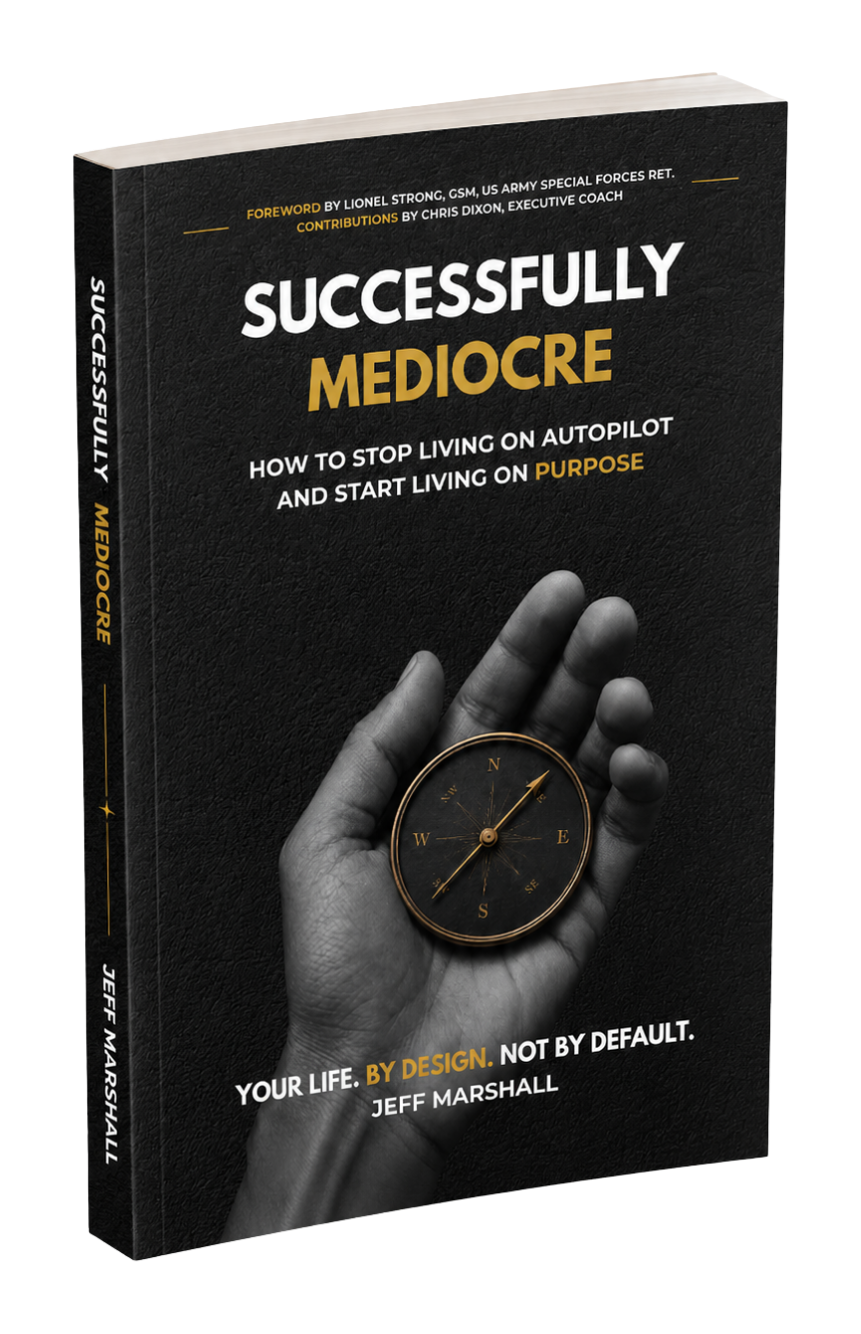
Successfully Mediocre was written for high performers who have learned how to succeed professionally but want a better system for making sure that success supports the life they actually want.
Jeff Marshall walks readers through the complete RISE Operating System: Reflect. Identify. Strategize. Execute.
Start With These Five Questions
- 01What are the three most important areas of my life right now?
- 02Does my calendar reflect those priorities?
- 03Where am I giving my best energy—and who gets what's left?
- 04What personal priority have I repeatedly postponed because of work?
- 05What would change if I applied the same strategic discipline to my life that I apply to my business?
Your Calendar Shows What Is Actually in Balance
Priorities are easy to describe. Calendars reveal what actually gets executed.
Open the previous thirty days and read them honestly. Where did your time go? Which priorities appeared consistently? Which priorities only ever existed in your head? And what did urgent work repeatedly replace?
Review your previous 30 days and mark your time as:
- Invested
- Time that moved important goals or relationships forward.
- Spent
- Necessary time that maintained life or business.
- Wasted
- Time that served neither.
The categories are a lens, not a scoring system. The value is in what you notice.
Work-Life Integration Does Not Mean Working All the Time
This is worth stating plainly: integration does not mean turning every part of life into work. It means refusing the false idea that professional success and personal fulfillment must always compete.
A founder can protect family time because it is strategically important, not merely sentimental. Health can be treated as infrastructure rather than something attempted after work. Time away from the company can improve perspective and judgment. Developing leaders reduces founder dependence. Clear boundaries support both performance and relationships.
If you want help turning that into a weekly operating rhythm, the 12-Week Install is built for exactly this, founder coaching gives you one-on-one support, and teams and organizations can run it together.
Stop Trying to Balance Two Lives
You do not have a work life and a personal life. You have one life. One finite amount of time. One set of values. One direction.
The goal is not to perfectly balance every hour. The goal is to make sure the direction you are moving professionally supports the life you are intentionally building personally.
If this sounds familiar, the companion piece to this article—how to stop living on autopilot—covers what happens when that direction stops being chosen at all. And if the imbalance has already started costing you health, energy, or relationships, read the 9 signs of founder burnout.
“Stop trying to balance two mountains. Choose the mountain you actually want to climb. Then make sure every step takes you higher.”
Success Should Support Your Life, Not Replace It
If you've built professional success but know there is more to the life you want to create, Successfully Mediocre gives you a practical system for turning purpose into direction, strategy, and execution.
Frequently Asked Questions

Time Management for Founders: How to Stop Being the Bottleneck
Founders don't usually need a bigger to-do list. They need clearer priorities, stronger delegation, and fewer decisions that depend on them. Here are practical ways to take back your time.
Read Article →
Founder Isolation: Why Building a Company Can Feel So Lonely
Why can entrepreneurship feel lonely even when you're surrounded by people? Learn what founder isolation is, how it affects leadership and decision-making, and practical ways to create more perspective and support.
Read Article →
100 Core Values Examples: How to Find the Values That Actually Guide Your Life
Explore 100 core values examples and learn a practical process for uncovering the three values that can guide your decisions, goals, relationships and life.
Read Article →